
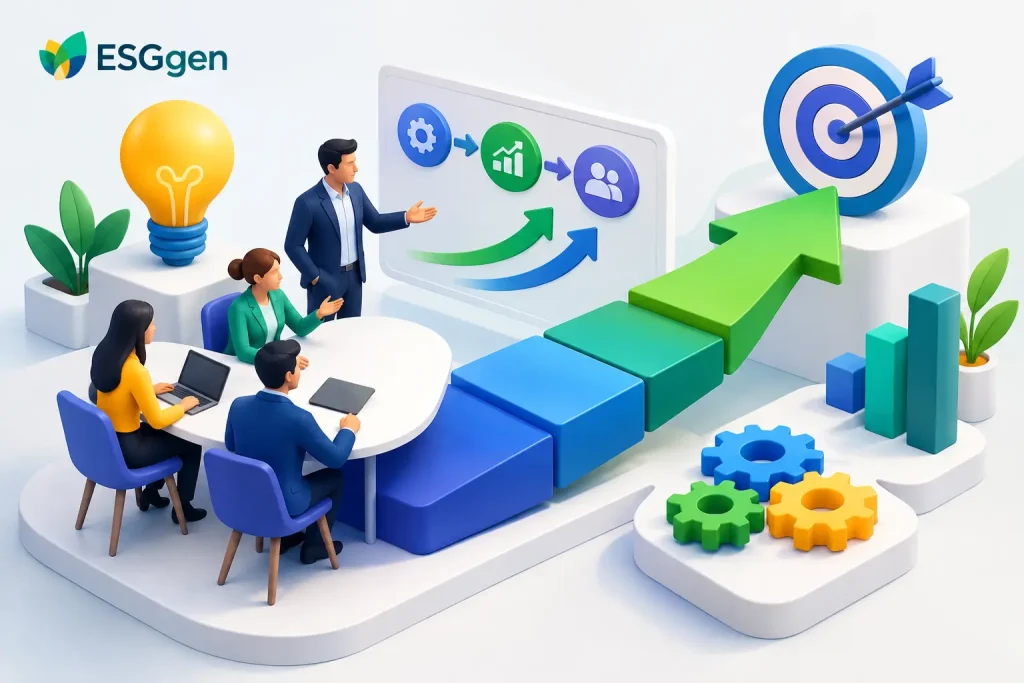
A sustainability target that sits only in a presentation deck will not reduce costs, strengthen customer trust, or prepare a business for tougher stakeholder expectations. Business transformation consulting helps leaders turn broad ambitions – including ESG commitments – into changes people can operate, measure, and improve.
For founders, executives, and operations leaders, this work is not about adding another initiative to an already busy agenda. It is about making better decisions on where to focus resources, how to improve performance, and how to build a business that can grow responsibly. The strongest transformation programs connect environmental and social responsibilities with commercial priorities such as operational efficiency, risk control, market differentiation, and long-term resilience.
Why business transformation consulting matters now
Many organizations have clear growth aspirations but fragmented ways of working. Data is scattered across departments. Sustainability efforts are led by a small team with limited authority. Policies exist, yet employees do not know how they influence daily decisions. In other cases, leaders recognize that ESG expectations are increasing but are uncertain which requirements apply, what information to collect, or where investment will produce a meaningful return.
These are business challenges, not simply reporting challenges. A consultant can bring structure to the work by identifying the gaps between the organization’s current operating model and its future goals. That includes examining processes, leadership accountability, data quality, workforce capability, supply chain exposure, customer expectations, and governance controls.
The value is practical. When transformation is designed well, a company can reduce resource waste, improve process consistency, strengthen decision-making, prepare credible disclosures, and show customers and investors that its commitments are supported by action. The priorities will differ by industry and maturity. A growing business may need foundational policies and simple performance measures, while an established company may need integrated reporting systems, supplier engagement, assurance readiness, and cross-functional governance.
Start with evidence, not assumptions
Transformation often loses momentum because teams begin with solutions before defining the problem. A new ESG policy, technology platform, or training program may sound promising, but it can become an expensive distraction if it does not address a material business need.
A disciplined evaluation establishes the starting point. Leaders should review current practices, available data, business objectives, stakeholder concerns, regulatory exposure, and performance barriers. This is also the time to clarify what success means. Is the immediate need to reduce energy use? Improve procurement controls? Build a credible ESG baseline? Prepare managers to lead organizational change? Or create a more scalable operating model as the company expands?
Discovery should involve more than senior leadership. Employees who manage operations, finance, human resources, procurement, sales, and compliance often see practical issues that do not appear in executive reports. Their input reveals where procedures are unclear, where data collection breaks down, and where a proposed change may create unnecessary workload.
This diagnostic phase creates a useful distinction between urgent gaps and important long-term improvements. Not every issue should be addressed at once. A focused transformation roadmap is more likely to earn internal confidence than an ambitious plan with no clear owner, budget, or timeline.
Build a strategy that joins ESG and business performance
ESG becomes more credible when it is connected to the way a company creates value. Environmental priorities may be linked to energy costs, materials efficiency, waste reduction, or supply continuity. Social priorities may support talent retention, workplace safety, customer confidence, and community relationships. Governance priorities can improve risk oversight, ethical conduct, accountability, and the quality of strategic decisions.
The strategic question is not, “What ESG activities should we add?” It is, “Which changes will make our business more responsible, competitive, and prepared for the future?” This question helps leaders avoid treating sustainability as a separate communications exercise.
An effective strategy defines material priorities, measurable outcomes, accountable owners, and decision rules. It also considers trade-offs. For example, replacing equipment may lower energy consumption but require significant capital expenditure. A supplier standard may strengthen responsible sourcing but affect pricing or lead times. The right response depends on the company’s financial position, risk profile, customer commitments, and ability to implement change well.
For many organizations, phased action is the sensible choice. Early projects can create proof of value while building the data, internal capability, and governance needed for more complex improvements later. This approach turns ESG from a perceived cost center into a managed business investment.
From strategy to operational design
A strategy only becomes transformative when it changes how work is done. This requires translating priorities into processes, roles, policies, controls, and performance measures that employees can use without confusion.
Consider a company seeking to improve its environmental performance. The operational design may include a baseline for electricity, fuel, water, or waste; monthly data ownership; site-level reduction targets; procurement criteria; maintenance procedures; and management review routines. If the company also wants stronger governance, it may establish approval thresholds, conflict-of-interest processes, board oversight, risk registers, and documented accountability for ESG performance.
The design must be proportionate. Small and mid-sized businesses do not need to copy the systems of large multinational corporations. Overengineering creates resistance and drains resources. At the same time, informal practices that depend entirely on one person’s knowledge create risk as the business grows. The goal is to build discipline that fits the organization’s scale while leaving room for expansion.
This is where hands-on consulting adds value. Advisors can help convert strategic intentions into workable tools, coaching leaders through decisions and helping teams adopt new routines. At Adcellent Biz, this practical pathway is reflected in the EFO Program, moving from evaluation and discovery through planning, design, implementation, optimization, and continuous improvement.
Implement with ownership and capability
Implementation is where transformation earns or loses trust. Employees need to understand not only what is changing, but why it matters to customers, colleagues, business performance, and future growth. A policy issued without training, manager involvement, and clear follow-up is unlikely to change behavior.
Leaders should assign ownership at the right level. Executive sponsorship signals that the work matters, while operational owners ensure actions happen in practice. Teams also need enough authority to resolve issues, request data, and escalate barriers. When ESG responsibilities are added to someone’s role without time, support, or decision rights, progress usually stalls.
Training should be specific to each audience. Directors may need guidance on oversight and risk. Managers may need support in setting targets and leading change. Operational teams may need clear instructions for data collection, safety practices, waste handling, or supplier evaluation. A single awareness session can start the conversation, but it rarely builds lasting capability on its own.
Implementation plans should include milestones and early indicators. Waiting until year-end to find out whether a program is working makes correction difficult. Monthly or quarterly reviews allow teams to identify incomplete data, delayed actions, unexpected costs, or resistance before those problems become embedded.
Measure what supports better decisions
Measurement is not a compliance exercise alone. Good data allows leaders to decide where to invest, what to improve, and how to demonstrate progress with confidence. The most useful metrics are reliable, relevant to material priorities, and connected to a clear owner.
A company does not need dozens of indicators at the start. It may be more effective to establish a small set of consistent measures, such as energy intensity, waste generation, employee training completion, safety incidents, supplier assessments, or governance actions completed. As systems mature, the organization can expand its reporting and align more closely with stakeholder or regulatory expectations.
Data quality matters as much as the metric itself. Teams should document definitions, collection methods, approval steps, and evidence sources. This preparation supports internal management reviews and makes future assurance or external reporting more credible. It also prevents a common problem: reporting figures that look promising but cannot be explained or verified.
Treat transformation as a management discipline
Business conditions change. Customer expectations evolve, regulations develop, costs fluctuate, and new risks emerge. A transformation program must therefore be reviewed and refined rather than treated as a one-time project.
Continuous improvement means checking whether actions are producing the intended commercial and ESG outcomes, learning from setbacks, and adjusting priorities with discipline. Sometimes the best next step is to scale a successful pilot. At other times, it is to simplify a process that created unnecessary burden or pause an investment until the organization is better prepared.
The organizations that gain the most from transformation are not necessarily those with the biggest budgets. They are the ones willing to make responsible growth part of how they lead, operate, and measure success. Start with an honest assessment, choose the changes that matter most, and give your people the structure to carry them forward.