
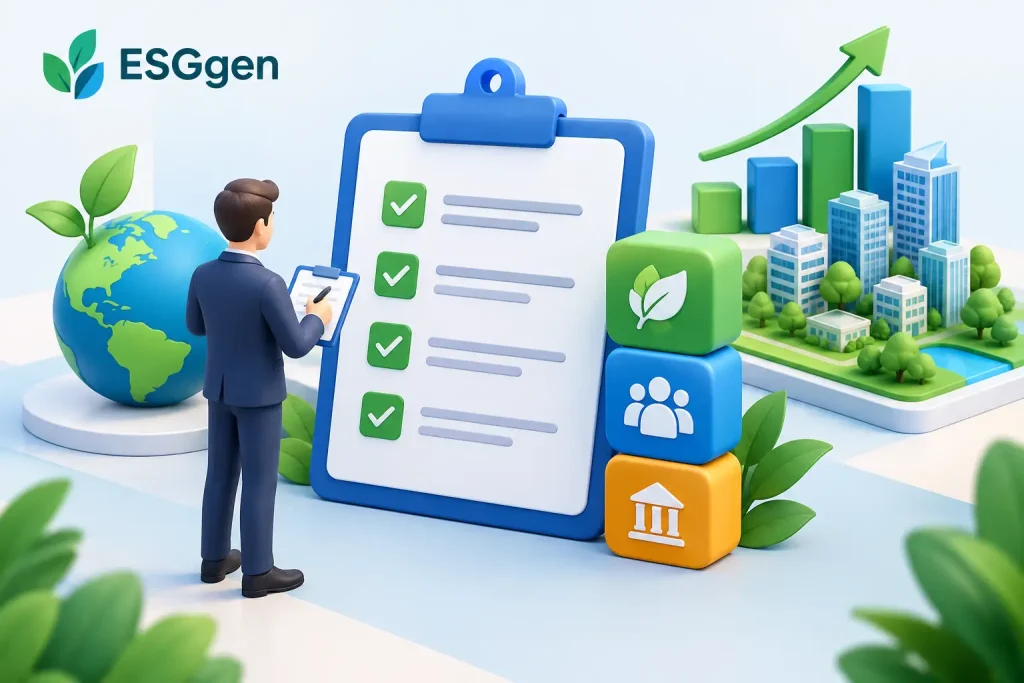
A credible ESG program rarely fails because leaders lack good intentions. It fails when policies, data, ownership, and daily operations do not match the commitments being made. An ESG gap assessment checklist gives your business a disciplined way to identify that disconnect before it becomes a reporting issue, customer concern, investor question, or operational cost.
For founders and executives, the goal is not to create a thick sustainability report. The goal is to understand where the business stands, decide what matters most, and implement improvements that strengthen resilience, efficiency, credibility, and long-term value.
What an ESG Gap Assessment Should Deliver
A gap assessment compares your current practices with the ESG expectations that are relevant to your organization. Those expectations may come from customers, lenders, investors, supply-chain partners, employees, industry standards, or emerging disclosure requirements. The result should be a clear, evidence-based view of three things: what is already working, what is missing, and what should happen next.
This work is most useful when it is connected to business priorities. A manufacturer may focus on energy use, waste, worker safety, and supplier controls. A service company may find its most material issues in data governance, talent retention, ethical sales practices, and business continuity. A startup may need basic policies, assigned accountability, and a reliable way to collect data before it attempts formal reporting.
There is no universal score that makes every company ESG-ready. Material topics depend on your sector, footprint, customer requirements, and growth plans. Still, the checklist below provides a practical foundation for moving from broad ambition to operational action.
ESG Gap Assessment Checklist: Start With Scope and Evidence
Before reviewing environmental, social, and governance topics, define the boundaries of the assessment. Clarify which legal entities, locations, business units, and supply-chain activities are included. Decide whether you are assessing current readiness for customers, internal improvement, financing, reporting, or all of these objectives.
Then collect evidence rather than relying on verbal assurances. Useful evidence includes policies, utility bills, waste records, payroll and training data, safety logs, supplier agreements, board minutes, risk registers, complaint records, and prior sustainability disclosures. If a process exists but cannot be demonstrated, it is a gap from an assurance and management perspective.
1. Leadership, Accountability, and Strategy
Start with governance because ESG initiatives without ownership often remain fragmented. Check whether senior leadership has approved an ESG direction that is tied to business strategy, not simply a communications statement. Identify who is accountable for decisions, who gathers data, who approves disclosures, and who reports progress to leadership.
Review whether ESG-related risks and opportunities appear in strategic planning, budgeting, enterprise risk management, procurement, and capital investment decisions. A company does not need a large sustainability department to establish discipline. It does need named owners, decision rights, meeting rhythms, and escalation paths.
Ask whether leadership can explain how ESG supports commercial outcomes. For example, energy efficiency can reduce operating costs, strong safety practices can protect productivity, and transparent governance can strengthen customer and investor confidence. If the answer is vague, the strategy needs further work.
2. Materiality and Stakeholder Expectations
A long list of ESG issues is not a strategy. Your assessment should determine which topics have the greatest potential impact on the business and its stakeholders. Consider customers, employees, local communities, regulators, lenders, suppliers, and shareholders where relevant.
Review how the organization currently listens to these groups. Customer surveys, employee feedback, grievance channels, supplier assessments, and investor discussions can all reveal priorities. The gap is not always a lack of engagement. Sometimes it is a lack of documented analysis, a failure to act on feedback, or an inability to explain why certain issues were prioritized.
Materiality should be revisited as the business changes. Entering a new market, adding a major customer, building a facility, or expanding a supply chain can change the ESG issues that deserve attention.
3. Environmental Management and Resource Efficiency
Assess what the business measures today: energy, fuel, water, waste, emissions, materials, packaging, and environmental incidents. The right starting point depends on operations. An office-based company may begin with electricity, business travel, procurement, and e-waste. A production business will likely require more detailed monitoring of energy intensity, water use, material loss, waste treatment, and emissions sources.
Look beyond data availability. Determine whether there are reduction targets, operational controls, responsibilities, and improvement plans. A utility bill shows consumption, but it does not show whether leaders understand the drivers of use or whether maintenance, equipment upgrades, and employee practices are being optimized.
Also assess compliance controls. Confirm that permits, inspections, waste handling, contractor requirements, and incident-response procedures are organized and current. Environmental performance is often where a practical ESG program can produce early savings, but only when baseline data is accurate enough to guide action.
4. People, Workplace Practices, and Community Impact
The social pillar is where stated values meet employee experience. Review workforce data and practices covering health and safety, labor standards, fair compensation, working hours, training, employee engagement, diversity, discrimination, grievance handling, and turnover.
Pay particular attention to whether policies are implemented consistently across sites, contract workers, and outsourced operations. A code of conduct is useful, but it does not replace training, accessible reporting channels, investigations, corrective action, and management review.
For businesses with community exposure or a large local workforce, assess community engagement and social impact practices as well. The right approach is proportionate. A small company may need clear hiring and safety practices first. A larger organization may need formal impact assessments, structured stakeholder engagement, and a documented process for managing grievances.
5. Ethics, Governance, and Control Systems
Governance gaps can undermine progress across every other ESG area. Check whether the business has current policies for anti-bribery and corruption, conflicts of interest, gifts and hospitality, whistleblowing, data privacy, cybersecurity, competition, and responsible procurement.
The key test is not whether a policy exists. Ask whether employees understand it, whether risks are assessed, whether incidents can be reported safely, and whether leadership reviews trends and corrective actions. For example, a whistleblowing channel that employees do not trust will not provide meaningful oversight.
Review board or management oversight, record keeping, delegated authority, and internal controls. As companies grow, informal decision-making can create exposure. Documented approvals and clear governance routines protect both the organization and the people responsible for running it.
6. Supply Chain and Third-Party Risk
Many ESG risks sit outside direct operations. Suppliers may affect your environmental footprint, labor practices, product quality, data security, and reputation. Assess whether vendor selection and renewal processes consider ESG criteria appropriate to the spend category and risk level.
For higher-risk suppliers, review contracts, supplier codes, questionnaires, audit rights, and follow-up processes. Smaller businesses do not need to audit every vendor immediately. A risk-based approach is more practical: focus first on critical suppliers, high-spend categories, labor-intensive services, and suppliers operating in higher-risk locations or industries.
7. Data, Targets, Reporting, and Assurance Readiness
A common gap is collecting numbers without a reliable process behind them. Identify each ESG metric you plan to monitor, the data owner, source system, calculation method, review process, and evidence retained. This creates a data trail that supports management decisions now and external assurance later.
Set targets only after establishing a credible baseline. Overly ambitious public commitments can create pressure without producing results. Better targets are relevant, measurable, time-bound, owned by leaders, and supported by implementation plans. Some measures can be absolute, such as total energy use, while others may be intensity-based, such as energy per unit produced. The appropriate choice depends on business growth and operating model.
When reporting, be transparent about scope, methodology, limitations, and progress. Reporting should reflect actual performance, not aspirations presented as achievements.
Turn Gaps Into an Implementation Roadmap
Once the assessment is complete, prioritize gaps using business impact, stakeholder importance, legal or contractual exposure, cost, effort, and expected value. Avoid treating every finding as equally urgent. A missing anti-bribery control, an unresolved safety risk, or inaccurate emissions data may require immediate attention. Other improvements can be planned over a longer cycle.
A useful roadmap separates actions into three horizons. The first 90 days should establish accountability, resolve critical risks, organize baseline data, and address obvious policy or compliance weaknesses. The next 6 to 12 months should focus on operational improvements, staff training, supplier engagement, and measurable targets. Longer-term work can include technology investments, deeper supply-chain programs, assurance preparation, and more advanced reporting.
Each action needs an owner, budget, deadline, success measure, and review point. This is where ESG becomes business transformation rather than a checklist exercise. Adcellent Biz supports this progression through a structured path from awareness and pre-assessment to strategy, implementation, assessment, assurance, and reporting.
Make the Assessment a Management Habit
An ESG gap assessment is not a one-time diagnostic to file away. Revisit it at least annually, and sooner when there are major changes in regulations, customer requirements, acquisitions, operations, or strategic direction. Regular review allows leaders to see whether actions are producing measurable improvements and whether new risks are emerging.
Start with the evidence you have, be honest about what is missing, and give your team permission to improve in stages. A practical first action taken with clear ownership will create more value than a perfect ESG ambition that never reaches the operating floor.