
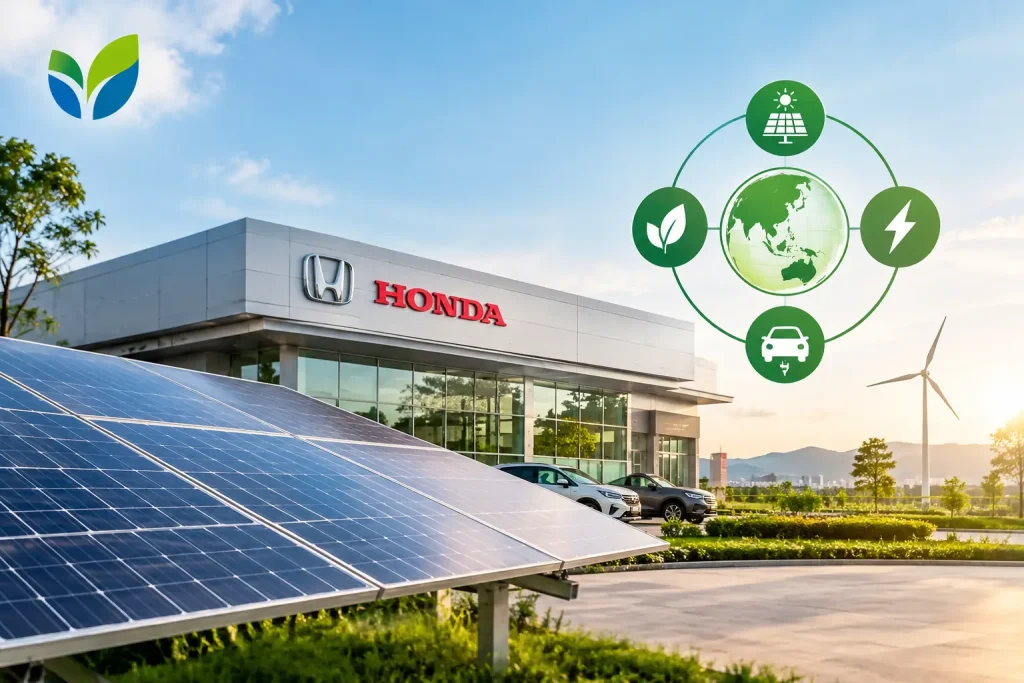
A manufacturing site does not reduce emissions through a policy statement. It does so when energy decisions change how the facility operates every day. Solar Renewable Energy as Solutions – Honda Malaysia as a case study offers Malaysian business leaders a useful example of how a visible environmental initiative can support wider ESG priorities, operating discipline, and long-term business resilience.
Honda Malaysia’s use of solar power at its Pegoh manufacturing operations in Melaka demonstrates a practical point: renewable energy is not only a sustainability project. When it is evaluated and implemented properly, it becomes an operational improvement initiative with environmental, commercial, and governance implications. source: https://www.orientaldaily.com.my/news/tech/2026/07/24/835459
Why solar is a business solution, not just an ESG gesture
For energy-intensive businesses, electricity is both a cost center and an emissions source. Rooftop solar photovoltaic systems can help offset a portion of daytime electricity demand, reduce exposure to grid-price volatility, and create measurable progress toward carbon-management targets. The benefit is especially relevant for facilities with broad roof areas and predictable daytime operations, such as factories, warehouses, offices, and retail sites.
The business case, however, depends on more than installing panels. Organizations need to understand their consumption profile, roof condition, available capital, financing structure, maintenance requirements, and expected changes in operations. A site that runs heavily during daylight hours may capture stronger value from onsite generation than one with limited daytime demand. Solar is a strong solution in many cases, but it is not automatically the first or only solution.
Honda Malaysia’s approach is valuable because it connects renewable electricity to an established production environment. It shows that decarbonization can be integrated into core operations rather than treated as a separate corporate campaign.
Honda Malaysia solar renewable energy solutions in practice
A solar installation at a manufacturing facility has consequences beyond the physical equipment. It requires engineering assessment, safety controls, supplier oversight, performance monitoring, and clear accountability for results. These are governance activities as much as technical ones.
For a company such as Honda Malaysia, solar adoption also reinforces the environmental pillar of ESG through lower reliance on conventional grid electricity. Yet the broader lesson is about integration. A credible initiative should be supported by baseline energy data, defined reduction targets, documented decision-making, and periodic review of actual performance against projections.
This is where many organizations lose momentum. They announce a sustainability target, complete a single project, and struggle to prove the outcome. A stronger approach treats solar as one part of an energy-management roadmap. The roadmap may include efficiency upgrades, equipment maintenance, demand management, employee awareness, procurement standards, and emissions reporting.
What Malaysian leaders can apply from the case
The Honda Malaysia example is most useful as a decision framework. First, identify where energy is consumed and when. A detailed energy baseline reveals whether solar generation will directly support operational demand and where efficiency improvements should happen first.
Second, prioritize projects based on measurable value. Carbon reduction matters, but decision-makers should also assess payback expectations, operating savings, implementation risk, business continuity, and stakeholder expectations. This keeps ESG investment connected to commercial outcomes.
Third, establish ownership before implementation begins. Finance, operations, facilities, procurement, and sustainability teams all influence results. Without a designated owner, reliable data and a review cadence, solar performance can become an isolated facilities issue instead of a strategic business asset.
Finally, report with discipline. Stakeholders increasingly expect organizations to substantiate environmental claims. Record the energy baseline, system capacity, renewable electricity generated, emissions methodology, maintenance activity, and any limitations in the data. This supports credible disclosures and helps leaders make better reinvestment decisions.
Managing the trade-offs
Solar projects have genuine constraints. Upfront investment can be significant, roof suitability varies, and generation changes with weather and daylight. Businesses must also consider lease terms, structural assessments, insurance, grid requirements, and future expansion plans. In some cases, energy-efficiency measures such as efficient motors, cooling optimization, or lighting upgrades may deliver faster returns before solar is installed.
That does not weaken the case for renewable energy. It strengthens it by ensuring the selected solution fits the organization’s actual conditions. The goal is not to copy another company’s installation. The goal is to build a practical pathway from energy data to implementation, assurance, and continuous improvement.
For organizations beginning this work, Adcellent Biz can help connect ESG priorities with operational assessment, solution planning, implementation support, and measurable reporting. The most valuable first step is simple: treat every kilowatt-hour as both a cost decision and an opportunity to create a more resilient business.